
In June the City Council adopted Ordinance 19-077 that enacted new regulations on short-term rentals in Jersey City.
These are the regulations that voters will either support or reject on November 5th, 2019.
- A Yes vote supports the new regulations.
- A No vote rejects/repeal the new regulations
The regulations can be found here.
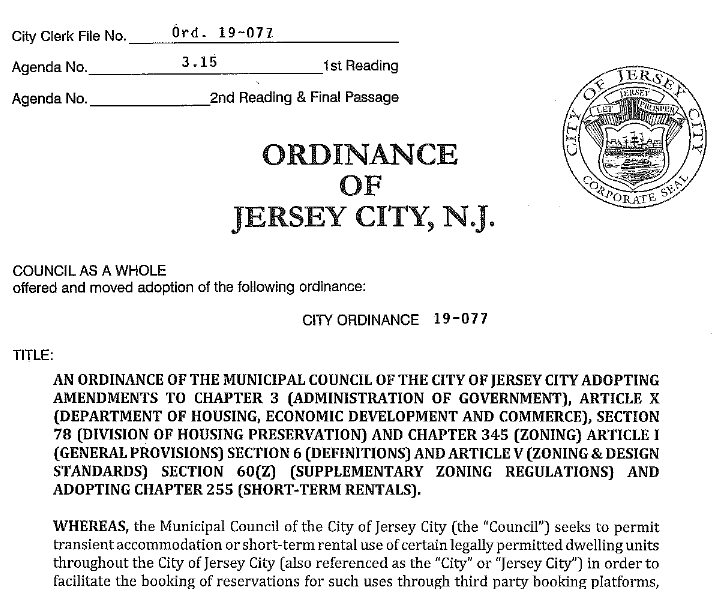
Ordinance 19-077
Rationale for Regulations
When adopting the ordinance, the city council sought to explain the rationale for doing so; the first part of the ordinance describes the reasons for adopting the regulations and the competing interests that needed to be balanced. The second part of the ordinance details the actual regulations.
This rationale is reproduced here in its entirety, and is important to consider when reading the specific regulations.
“WHEREAS, the Municipal Council of the City of Jersey City (the “Council”) seeks to permit transient accommodation or short-term rental use of certain legally permitted dwelling units throughout the City of Jersey City [also referenced as the “City” or “Jersey City”] in order to facilitate the booking of reservations for such uses through third party booking platforms, and promote tourism and economic vitality in the City; and
WHEREAS, the short-term rental of dwellings and dwelling units can provide a flexible housing stock that allows travelers a safe accommodation while contributing to the local economy, promoting travel and tourism and supporting the local tourism industry and business community; and
WHEREAS, the short-term rental of dwellings and dwelling units can provide homeowners with an opportunity to maintain ownership of property in difficult economic circumstances; and
WHEREAS, the needs of long-term residents should be balanced with the allowance of short-term rentals; and
WHEREAS, the Council recognizes that unregulated short-term rentals can create disproportionate Impacts related to their size, excessive occupancy, and lack of proper facilities; and
WHEREAS, the presence of short-term rentals of residential dwelling units in established residential neighborhoods can create negative compatibility impacts and nuisance violations, which include, but are not limited to, excessive noise, on-street parking, accumulation of trash, and diminished public safety; and
WHEREAS, long-term rental housing vacancy rates in the City are at low levels, making it increasingly difficult for people to obtain permanent housing in Jersey City; and
WHEREAS, removal of residential units from the long-term housing market for short-term rental use contributes to low vacancy rates; and
WHEREAS, the conversion of long-term housing units to short-term rentals will result in the loss of long-term housing for Jersey City residents; and
WHEREAS, it is in the public interest that short-term rental uses be regulated in order to help preserve housing for long-term tenants and to minimize any potential deleterious effects of short-term rental properties on other properties in the surrounding neighborhoods in which they are located; and
WHEREAS, the Council finds that there is a substantial interest in furthering the public health, safety and welfare by controlling density, by protecting the residential character of areas designated for residential use, by establishing and enforcing minimum life safety standards, and by preserving the long-term rental housing market located within the City.”
Key Points About the Regulations
The second part of ordinance details the actual regulations. Even though the regulation text is long and consists of many definitions, we encourage you to explore it. Link is provided here.
The key points about the new regulations are that:
- homeowners who live on-site are permitted to share their primary residence for 365 days a year (§255-2.b)
- in properties with four (4) or fewer dwelling units
- there is an annual 60-day cap on short-term rentals when the property owner does not live on-site (§255-2.e)
- on-onsite owners of more than one unit within the same building as their primary residence, may operate up to two additional units as short-term rentals within the building, when they live on site (§255-2.b.iii to v)
- in properties with more than four (4) units, short-term rentals are:
- prohibited when the owner does not live on-site (§255-2.f)
- allowed 365 days per year when owner lives on-site (§255-2.b.i)
- in properties with four (4) or fewer dwelling units
- people are prohibited from renting out dwellings that are not within their primary residence on a short-term rental basis
- renters are prohibited from serving as short-term rental hosts (§255-2.g)
- owners that were operating two different properties as short-term rentals at the time of the ordinance’s adoption (June 2019) may under certain conditions continue to do so even if one of the properties is not owner occupied (§255-2.h).
- existing short-term rental contracts that are not permitted under the new regulations must be phased out by Jan. 1, 2021 (§255-2.i)
The regulations also:
- require all operators to obtain a permit from the city (initial permit registration fee $250), and for subsequent years obtain an annual renewal (fee $200) (§255-3.b to e) ;
- require all operators to provide contact details for a responsible party (e.g. a super / rental manger) that can be contacted 24/7 in case of complaints or problems with the STR property (§255-4.a.vi) and shall respond within 2 hours of being contacted in case of urgent issues (§255-6.h) ;
- state that if an operator receives three convictions relating to their operation of the short term rental, their license to operate shall be revoked (§255-6.h). E.g. if convicted in court for safety issues, noise violations, etc., three times, the license may be revoked;
- requires that the rental property passes fire inspection every three years (§255-4.b);
- requires that the property is covered with general liability insurance with a minimum cover of $500,000 (§255-4.e.ii) ;
- requires that the primary short-term renter is 21 years old and that guests under 18 years old are accompanied by guardian (§255-4.h) .
The new rules only apply to rental periods of 28 days or less (i.e. 4 weeks or less). Rentals for periods of 29 days or longer do not fall under the regulations.
Commentary / Analysis
The rules are aimed at preventing investors and commercial operators from taking over homes and removing them from the residential market, turning them into de-facto airbnb hotel rooms or whole-house hotels. It is these commercially run operations that lead to most complaints from residents and remove a significant number of units from the residential real estate market.
The rules seek to balance the property rights of residential home owners and their ability to “maintain ownership of property in difficult economic circumstances” while also minimizing negative effects of short-term rental properties on other properties in the neighborhoods in which they are located.
The rules therefore allows home owners to rent out their primary residence as a short term rental (STR) on internet platforms such as Airbnb, VRBO, etc:
- for an unlimited amount of time when home owners are living/present in the home.
- for 60 days per year when the home owners are not present if the dwelling is in a property with four or fewer units
- in addition to the unlimited amount of time when the home owners are present / living in the home.
- If the dwelling is in a property with five or more units, and the condo association’s rules allows for short term rentals, the owner is allowed to rent out parts of their home on short term basis when they are present/living there. When the owner is not living in the property the owner is not allowed to rent out their unit on a short term basis.
- Resident owners are further allowed to rent out two more units in their primary residence if the primary residence consists of 4 or fewer units – e.g.: an owner occupied 4 floor building with one apartment on each floor.
Renters
Most rental agreements already prohibit a renter from subletting their leased apartments, including on a short term basis. For example New Jersey Association of Realtors’ Standard Form of Residential Lease contains such language.
The proposed regulations however also explicitly prohibit renters from subletting their rented home on short-term rental basis. Again, these short-term rental regulations only apply to periods that are 28 days or shorter – i.e. renters and real-estate investors can continue to rent out properties for periods longer than 28 days.
Taken together the rules will prevent commercial operators from taking over apartments and removing them from the residential market and turning them into de-facto airbnb hotel rooms or whole-house hotels.
Make up your own mind!
We encourage you to read the regulations and make up your own mind on whether the regulations strikes an equitable balance between the rights of property owners on one hand and the rights and interest of Jersey City residents and neighbors on the other.
The regulations can be found here: https://www.jerseycitynj.gov/UserFiles/Servers/Server_6189660/File/Agendas,%20Mins,%20Res%20&%20Ord/2019%20Ordinances/OR2%202019%2006%2025.pdf.
Regulations in Cities Around Jersey City
The above explains the regulations that voters will consider when going to the ballots on November 5, 2019. To evaluate whether you consider these regulations fair and balanced, it is worthwhile to compare them with short term rental regulations in other cities. Read more here about the regulations in New Jersey towns close to New York City and other US Cities.
 Jersey City Short-Term Rental Facts